
Every society has that show.
The one the MD announces and half the room goes quiet. The one where experienced performers start running through the casting in their heads before the applause has died down. The one where someone always says “are we sure?” in the car park afterwards. You’ve chosen one of the hardest musicals to perform.
Those shows exist for a reason. They are genuinely hard. Not “challenging” in the way that every show is challenging. Hard in the way that makes a society level up or fall apart.
But here’s the thing. Societies choose them anyway. Year after year. And most of the time, they are right to.
This post breaks down what actually makes a musical difficult to perform, which shows are the hardest, and why the most ambitious societies keep putting them on the stage.
What Actually Makes a Musical Hard to Perform?
Not all difficult shows are difficult in the same way. Before we get into the list, it helps to know what we’re measuring.
There are four main difficulty factors in musical theatre.
- Vocal demands. Range, stamina, and technique. Some scores push singers to the edge of what the human voice can comfortably do. Some require eight shows a week of material that would be demanding in a single concert. Amateur performers don’t have the luxury of full-time vocal coaching and rest days. That matters.
- Dance and physical demands. Not all musicals need strong dancers. Some need exceptional ones. There’s a difference between a cast that can move well and a cast that can execute technically demanding choreography eight times over a production run while also singing and acting.
- Emotional and acting complexity. Some roles require performers to sustain real psychological depth across a two-hour show. Some scripts don’t give you laughs to break the tension or set pieces to hide behind. The acting has to do all the work.
- Technical and production demands. Set, costume, staging concept, orchestra size. Some shows require production values that stretch any budget. Others require a director and creative team with genuine vision, not just competence.
The hardest shows on this list are hard across multiple categories at once. That’s what puts them here.
The Hardest Musicals to Perform
Sweeney Todd
Sweeney Todd is the show that separates societies who can do Sondheim from societies who think they can.
The score is extraordinary and unforgiving. It sits at the intersection of opera and musical theatre, and it doesn’t compromise in either direction. The intervals are brutal. The harmonies are complex. Todd and Mrs Lovett are on stage for most of the evening, carrying vocal weight that would challenge professional singers with full-time support.
And then there’s the acting. Todd is a psychologically layered character who needs to be genuinely terrifying and genuinely sympathetic. The relationship between Todd and Lovett is the engine of the whole show. Get it wrong and the audience watches two people sing difficult songs at each other for two hours.
The comic darkness needs perfect timing. Too broad and it tips into pantomime. Too restrained and it loses the audience entirely.
Why societies still do it: Because it is Sondheim’s masterpiece. Because audiences come in already excited. Because when a society has the right two leads and an MD who knows the score, the result can be genuinely extraordinary. Sweeney Todd productions that work really work. The ambition is worth it.
Company
Company is deceptive. It looks manageable on paper. A cast of adults, largely domestic settings, no massive production demands. And then you actually try to do it.
Bobby is one of the most difficult roles in musical theatre. He is in almost every scene, says less than everyone around him, and has to convey an entire interior life through what he doesn’t do as much as what he does. The audience needs to understand him completely by the end of the show without him ever fully explaining himself. That is a very specific kind of acting skill.
The show is non-linear and essentially plotless. It requires a director who understands what it’s trying to say, and a cast who can find the emotional truth in material that doesn’t give them a conventional dramatic arc to hang on to.
Being Alive, the Act Two climax, is one of the most demanding numbers in the Sondheim catalogue. It has to land as a genuine breakthrough. If it doesn’t, the whole evening feels unresolved.
Why societies still do it: Prestige, mostly. Company is the kind of show that gets reviewed, talked about, and remembered. The societies that do it well tend to be the societies that are serious about what they’re making. It also has a devoted fanbase who will come and see it wherever it’s on.
A Chorus Line
Let’s be direct about this one. A Chorus Line needs dancers. Real dancers. Not performers who move well. Dancers with genuine technique, trained bodies, and the ability to execute demanding choreography at pace while also singing and acting.
The material strips away everything. There is no set to speak of. There are no costumes beyond rehearsal clothes and the finale. The show is seventeen people standing in a line telling you who they are, and whether you care depends entirely on whether the cast can make you care. That requires acting of real quality from every single person on stage, not just the leads.
The score is strong throughout and asks for a range of vocal styles. But the dancing is the barrier. Most societies know this. The ones that press ahead do so because they have the performers to justify it.
Why societies still do it: Because A Chorus Line is about exactly what am dram people love about performing. The audition, the need to be seen, the fear of not making it. Audiences full of performers find it deeply affecting. And societies that have the dance talent to pull it off have every reason to show it off.
West Side Story
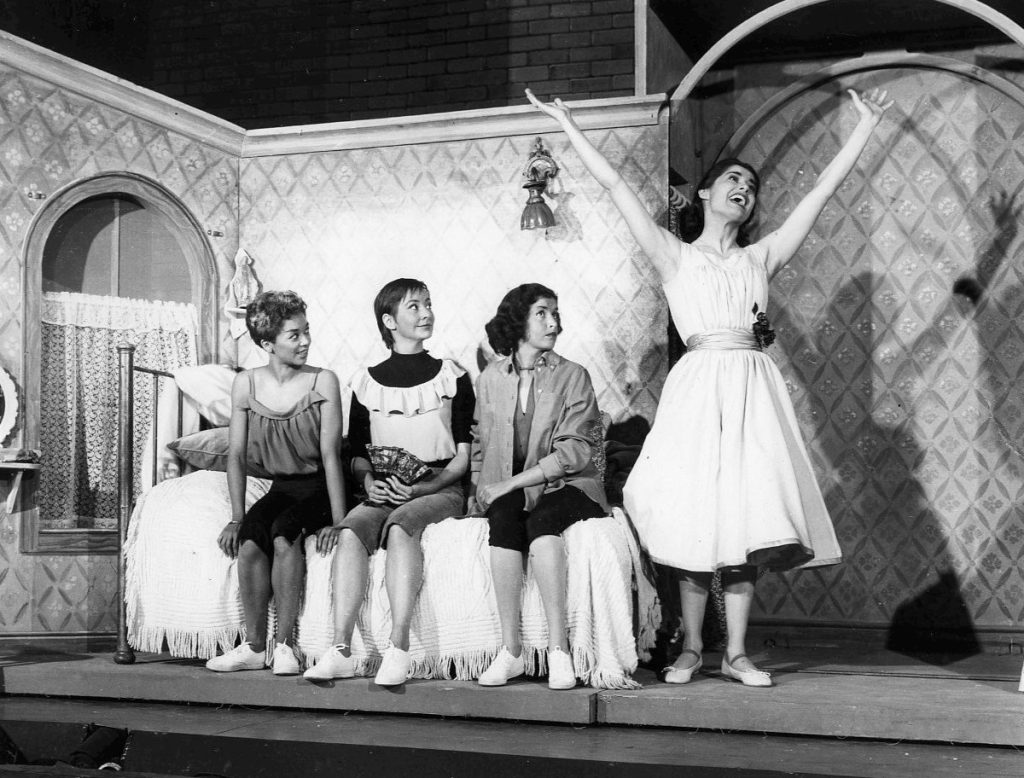
West Side Story is a show where you feel the gap between amateur and professional most acutely if the right elements aren’t in place.
The choreography is the first challenge. The original Robbins choreography, or any serious staging of it, demands genuine technical skill. The gang sequences are physically relentless. You cannot walk through them.
The vocal demands are significant. Maria requires a soprano with real classical technique. The score sits in a range that is genuinely difficult to sustain, and the role is on stage for most of the show. Tony needs power and lyricism. Tonight, One Hand One Heart, Something Somewhere: none of these are forgiving numbers.
And then there’s the material itself. The show deals with racism, violence, and tragedy. It needs to be handled with real seriousness. Productions that play it safe or sanitise the edges do the show a disservice and confuse the audience about what they’re watching.
Why societies still do it: Because West Side Story is one of the most iconic musicals ever written and audiences will always come. Because it gives a society’s strongest dancers a genuine showcase. Because when it works, there are few shows more powerful.
Into the Woods
Into the Woods is the Sondheim show that am dram societies attempt most often, and still regularly underestimate.
Act One is manageable. The fairy tale framework gives performers something to hold on to, and there is humour and lightness to balance the difficulty. Act Two is where societies discover what they have actually taken on.
The score in Act Two becomes darker, more complex, and more demanding. The harmonies in pieces like No More and No One Is Alone require real precision. The show stops being funny and starts being genuinely difficult in every sense.
The acting demands in Act Two are also significant. Characters who seemed straightforward in Act One have to carry real emotional weight. The Witch’s journey in particular requires a performer who can sustain complexity across a full evening.
Why societies still do it: Because Into the Woods is beloved. Because the double-casting possibilities give a strong company a lot to play with. And because Act One is genuinely joyful to perform. Societies go in for Act One and find Act Two waiting for them.
Sunday in the Park with George
Sunday in the Park with George is the rarest show on this list. Most societies never attempt it. The ones that do are making a statement.
There is no plot in any conventional sense. The show is an exploration of artistic obsession, creative isolation, and what it costs to make something that matters. It is almost entirely reliant on two central performances and a director who understands what the show is trying to do.
The score is among Sondheim’s most complex. Finishing the Hat is one of the most famous numbers in the musical theatre repertoire and one of the hardest to pull off. It has to feel like a revelation. If George doesn’t land it, the whole first act falls apart.
Staging the show requires genuine creative vision. There are no easy production choices. The second act, set in the 1980s, is abstract in a way that demands an audience who is prepared to meet the show on its own terms.
Why societies still do it: Because Sunday in the Park with George is the kind of show that serious societies produce when they want to be taken seriously. It is a statement of ambition and artistic intent. The societies that stage it well earn real respect for doing so.
Next to Normal
Next to Normal is a different kind of hard.
It is a small-cast rock musical about a family living with a mother’s bipolar disorder and the grief underneath it. There is no spectacle. There is no relief. The show does not let anyone off the hook, on stage or in the audience.
Diana is one of the most demanding roles in contemporary musical theatre. The rock score requires power, control, and stamina. The acting requires a performer who can sustain psychological complexity and emotional rawness across a full evening without tipping into melodrama. It is the kind of role that gets talked about for years when it’s done well.
The rest of the cast are not supporting players carrying a star turn. Every character has a fully realised emotional journey. The family dynamics need to feel real, not performed.
Why societies still do it: Because Next to Normal is a small cast with no technical demands, which makes it accessible in production terms even if it is vocally and emotionally brutal. Because when a society has a performer who can play Diana, the audience response is unlike almost anything else in the amateur theatre calendar. And because the material matters. Audiences leave changed by it.
The Shows That Look Harder Than They Are
Not every reputation is earned.
- Oklahoma! is often treated as a safe choice, which undersells how enjoyable it is to perform. The score is beautiful, the material is warm, and the dance sequences, while needing good execution, are not the technical gauntlet that West Side Story represents. It is a show that rewards a strong ensemble and a good MD without punishing you for not having a company full of elite performers.
- Guys and Dolls has a reputation for the vocals and the accents, but it is one of the most performable shows in the musical theatre catalogue. The comic roles are genuinely fun to play. The score is well within reach for a capable society. The accents are manageable with preparation. Do not let the reputation put you off.
- Godspell looks deceptively loose and spontaneous. It is actually very playable for a society with good ensemble performers and a willingness to commit. The vocal demands are real but distributed. It does not require one star to carry it.
How to Know If Your Society Is Ready
Before you announce the show, ask these questions honestly.
- Do you have the leads? Cast first, announce second. Always. If you cannot name the person playing Todd, Diana, or Bobby right now, do not book the rights yet.
- Is your MD confident with the score? Sondheim in particular requires an MD who has spent real time with the material. An MD who is learning the score alongside the cast is a red flag.
- Does your choreographer have what the show needs? West Side Story and A Chorus Line need someone with serious dance training behind the choreography. Be honest about what you have.
- Can your production team handle the demands? Some shows require significant production investment. Know your budget before you commit.
- Is your rehearsal schedule realistic? The hardest shows need more rehearsal time, not the same amount. Build that in from the start.
The honest answer to some of these questions will sometimes be: not yet. That is not failure. That is good planning. Doing a show badly serves nobody. Coming back to it two years later when you are ready is the smarter move.
Why Difficult Shows Are Worth It
There is a version of am dram that plays it safe every season. Crowd-pleasing shows, known scores, reliable box office. Nothing wrong with any of that.
But the productions that stay with you are rarely the easy ones.
When a society takes on a genuinely difficult show and pulls it off, something different happens. The cast grows in ways they would not have otherwise. The audience knows they have seen something that required real courage and real skill to put on stage. The reviews are better. The conversations in the bar afterwards are better. The memories last longer.
The hard shows leave the biggest mark. On the performers who do them. On the audiences who see them. On the societies that are brave enough to choose them.
That is why they keep appearing on season lists, year after year. Not in spite of the difficulty. Because of it.
Frequently Asked Questions
What is the hardest musical to perform vocally? Sweeney Todd is widely considered one of the most vocally demanding musicals in the repertoire. The score sits between opera and musical theatre and requires two leads with exceptional stamina and precision. Next to Normal is also brutally demanding for its lead, with a rock score that requires power and control across a full evening.
What is the most technically difficult musical for amateur theatre? West Side Story and A Chorus Line both place exceptional demands on a company’s dancers. West Side Story also has significant vocal demands on top of the choreography. Sunday in the Park with George is technically simple in production terms but places enormous demands on direction, design, and two central performances.
What makes Sweeney Todd so difficult to perform? Three things: the score is extraordinarily complex, requiring near-operatic precision from the leads; the acting demands are intense, combining psychological darkness with comic timing; and the show is long and relentless, with no easy stretches for the principal performers to recover.
Are Sondheim musicals too hard for amateur theatre? Not if the right show is matched to the right company. Into the Woods and Company are performed regularly and successfully by amateur societies. Sweeney Todd and Sunday in the Park with George are rarer but absolutely achievable by serious companies with the right cast and creative team. The answer is not whether a society can do Sondheim. It is whether a society can do this Sondheim show, right now, with the people they have.
What musicals should a society avoid if they are not experienced? Shows that place exceptional technical demands on a specific department are the highest risk. West Side Story without strong dancers, Sweeney Todd without the right two leads, and Next to Normal without the right Diana are all shows where the gap becomes very visible very quickly.
Is Next to Normal suitable for amateur theatre? Yes, and it is done regularly by amateur societies. The production demands are minimal. The challenge is almost entirely in the performances. It is worth noting that the subject matter is serious and requires care in how it is handled, both in rehearsal and in any audience communications.
What is the hardest Sondheim musical to perform? Most performers and directors who know the catalogue point to either Sweeney Todd or Sunday in the Park with George. Sweeney Todd because of the combined vocal and acting demands on the two leads. Sunday in the Park with George because the whole show depends on two performances and a directorial vision, with nothing else to fall back on.