I’m directing Now That’s What I Call a Musical for Erewash Musical Society in March 2027. It’s my first time in the director’s chair. I fell for the show from the stalls first: I saw the professional tour at the Theatre Royal in Nottingham and loved it.
Now that the show is available for amateur licence in the UK and Ireland, I expect a lot of societies to look at it. This guide is for them, and for the performers who’ll be auditioning. It covers the story (without the big twists), every character, the full song list, how licensing works and what I’ve learned from directing it so far.
What Is Now That’s What I Call a Musical?
Now That’s What I Call a Musical is a British musical comedy written by Pippa Evans. It tells the story of two best friends through the hits of the 1980s. The title comes from the NOW That’s What I Call Music compilation albums, and the show was created to celebrate their 40th anniversary.
The NOW albums, 40 years on
If you grew up in the UK in the 80s, you probably had at least one NOW tape. The series started in 1983 and is still going. The show’s producers say the brand has sold an estimated 200 million copies worldwide. That shared memory is the whole point of the musical. Your audience will know every song before the band plays the first bar.
Pippa Evans and the 2024 to 2025 tour
The world premiere opened at Aylesbury’s Waterside Theatre on 6 September 2024 and then toured the UK and Ireland into spring 2025. Craig Revel Horwood directed and choreographed it. It was produced by ROYO, Universal Music UK, Sony Music Entertainment and Mighty Village.
Nina Wadia led the tour as Gemma, with Melissa Jacques and Sam Bailey sharing April. Pippa Evans is a comedian and improviser whose West End credits include Showstopper! The Improvised Musical, and you can hear that improviser’s ear for a quick line throughout the script.
The tour had a gimmick: special guest stars from the NOW era, including Sinitta, Sonia, Carol Decker and Jay Osmond, appearing at selected performances. The amateur version keeps a trace of that idea in the star role, which I cover below.
Is it a jukebox musical?
Yes. It’s an original story built around existing pop songs, which is the textbook definition of a jukebox musical. It sits in the same family as Mamma Mia! and Boogie Nights: a new plot, with the songs placed where they fit the moment. It isn’t a biography of any band.
That matters for casting and rehearsals. The songs aren’t written for the characters, so the drama depends on your actors making a familiar hit sound like something their character would say. I’ve written more about why performers love this format in Jukebox Musicals: The Performer’s Dream?
The Story (Spoiler-Light)
I’ve kept the biggest surprises out of this section. If you’re a society reading for selection, get a perusal copy and enjoy the twists yourself.
Birmingham, 1989
Gemma and April are best friends at school in Birmingham. Young Gemma wants a steady life and dreams of becoming a nurse. Young April wants out: she’s going to be famous. Together they plan their futures around magazine quizzes and dream about Rick Astley.
Around them are Gemma’s family (Mum, Dad and her brother Frank) and the boys from school. Barney is awkward and sweet, and he’s often on the receiving end of the girls’ teasing. Steve works at Planet of the Tapes, the local video shop, and is the object of a serious teenage crush. Then there’s Tim, a confident young yuppie with a mullet.
The reunion, 2009
Twenty years later, The Palace pub hosts the “Class of 89” reunion. Gemma is a nurse, married to Tim, and she arrives with Frank. She hasn’t seen April in years. Barney now runs The Palace.
The present-day story follows that night and the weeks after it. Old friendships are tested and old flames come back. Gemma starts to ask whether the life she chose at 18 is the one she wants at 38. Act 2 brings a crisis that forces the two friends to face what went wrong between them. I’ll leave the rest for you to find.
How the two timelines work
The show moves between 1989 and 2009 throughout, scene by scene. The adult characters share the stage with their younger selves. Some numbers are shared across the decades, with the younger and older versions of a character singing together. That structure gives the show its emotional weight. It’s also the biggest staging challenge for a director, which I come back to below.
Why I Chose to Direct It: A Musical Led by Women
I love 80s music, and jukebox shows suit my voice. I loved playing Trish in Boogie Nights with EMS. But the thing that made me want to direct Now That’s What I Call a Musical was who tells the story.
It’s a female-led musical told from a woman’s point of view. Too often, women in musicals exist as the object of a man’s storyline: the girl he wants, the girl he loses, the girl he wins back. Here, the men orbit the women. Gemma and April drive every scene, and the central love story is arguably their friendship.
With two Gemmas and two Aprils, there are four female leads at the heart of this show. That’s rare, and it’s a gift for any society with strong women in the membership. If you’ve ever read my piece on casting fatigue, you’ll know how often our best performers end up fighting over one or two good female roles. This show spreads them out.
Characters in Now That’s What I Call a Musical
The script lists 14 named principals plus a star role, and a sizeable ensemble. Most principal roles come in pairs: a young 1989 version and an adult 2009 version.
The core four: Gemma, April and their younger selves
Gemma Warner (late 30s to early 40s) is a nurse at her school reunion. She’s reflective and resilient, and she’s carrying a lot of unmet expectations. She’s the narrator in all but name, and she’s on stage for most of the show.
April Devonshire is Gemma’s bold, charismatic best friend. She’s fiercely independent and much more complicated than her confidence suggests. April needs a performer who can be funny and then break your heart a scene later.
Young Gemma is idealistic and conscientious, standing on the edge of adulthood and wanting stability and purpose.
Young April is outspoken, fearless and ambitious. She’s desperate to escape her home town and chase stardom. She carries a lot of Act 1’s energy and several of its biggest numbers.
The Warner family: Mum, Dad, Frank and Young Frank
Frank is Gemma’s brother: witty, impulsive and warm-hearted, and he hides his vulnerability behind humour. Young Frank is restless and impatient to prove himself. The adult Frank and Gemma double act opens the show, and their sibling banter is some of the funniest writing in it.
Mum is loving and practical, with a sharp sense of humour. Dad is gentle, traditional and quietly supportive. Both are terrific roles for older members, and Dad leads an early family number.
The men: Tim, Barney and Steve
Tim is Gemma’s husband: charismatic, self-centred, and driven by status and appearances. Young Tim is the confident, charming yuppie Gemma first falls for.
Barney is awkward but endearing, a former schoolmate whose quiet loyalty pays off. Young Barney is socially anxious and romantically earnest. He gets one of Act 1’s best comic set pieces.
Steve is wry, self-aware and comfortable in his own skin. Young Steve is cool and aloof in his video shop, and every teenage girl’s fascination.
The star role: Sonia or Boy George
The star is an 80s pop icon who appears to Gemma as a guiding presence at a key moment in Act 2. The script gives you a choice of Sonia or Boy George, each with their own scene and their own number. You can alternate across your run, but only one can appear in any single performance, and you tell your licensing agent which option you’ve chosen.
At EMS we’re doing Sonia. It’s a fun, scene-stealing cameo, and it suits a performer who wants a small role with a big moment.
The ensemble and doubling
The ensemble roles include Ms Dorian, Trevor Horn, a DJ, nurses, a pizza delivery man (who isn’t quite what he seems at a hen do), police officers, Dave, Doris, Anita and assorted reunion guests. The script encourages doubling, and it notes that the numbers can expand or contract to fit your company. That flexibility makes it workable for a society of 20 or a society of 50.
Paired roles at a glance
| Character | In 1989 | In 2009 |
|---|---|---|
| Gemma | Conscientious, dreams of nursing and a steady life | A nurse at her school reunion, questioning her choices |
| April | Fearless, determined to be famous | Bold and independent, back after years away |
| Frank | Restless, impatient to prove himself | Witty and warm, Gemma’s reunion wingman |
| Barney | Shy, romantic, teased at school | Runs The Palace pub |
| Steve | Cool video shop assistant | Wry and self-aware |
| Tim | Confident young yuppie | Gemma’s status-driven husband |
Songs in Now That’s What I Call a Musical
There are more than 20 numbers, plus an overture, entr’acte, bows and a megamix. The list below follows the libretto I’m working from. Your licensed edition may differ slightly.
| Act | Song | Sung by |
|---|---|---|
| 1 | Relax (overture) | Company |
| 1 | Girls Just Wanna Have Fun | Young April, Young Gemma |
| 1 | Girls Just Wanna Have Fun (reprise) | Young April, Young Gemma |
| 1 | Tainted Love | Dad, Young Frank, Young Gemma |
| 1 | Video Killed the Radio Star | Trevor Horn, Young April, ensemble |
| 1 | Every Breath You Take | Young Barney |
| 1 | You Spin Me Round | Young April, Young Barney |
| 1 | St. Elmo’s Fire (Man in Motion) | Young Gemma, Young April |
| 1 | I’m Gonna Be (500 Miles) | Young Gemma, Young April |
| 1 | When Will I Be Famous? | Gemma, Frank |
| 1 | Flashdance (What a Feeling) / Ride On Time | Young Gemma, Young Tim, ensemble |
| 1 | Everybody Wants to Rule the World | Young April, Young Gemma |
| 1 | A Little Respect | Young Gemma, nurses, Pizza Delivery Man |
| 1 | I’ll Stand By You | Gemma, Frank, Young Gemma, Young Tim, Mum |
| 2 | Entr’acte | Band |
| 2 | Gold | Tim |
| 2 | Walking on Sunshine | Gemma, April, company |
| 2 | You Spin Me Round (reprise) | Steve, April |
| 2 | Heart of Glass | Frank |
| 2 | Mickey | April, Tim, ensemble |
| 2 | St. Elmo’s Fire (reprise) | Gemma, Young Tim |
| 2 | Hold Me Now | Gemma, Young Gemma |
| 2 | You’ll Never Stop Me Loving You (Sonia version) or Karma Chameleon (Boy George version) | Star, Gemma |
| 2 | Too Much Too Young | Young April, Young Gemma, nurses |
| 2 | The Only Way Is Up | Gemma, April, company |
| 2 | I’m So Excited (bows) | Full company |
| 2 | Megamix | Full company |
Showcase numbers for performers
Young April has the biggest sing in Act 1: Girls Just Wanna Have Fun opens the 1989 story, and she’s in most of the act’s big numbers. If you’re a young belter with comic timing, this is your role.
Young Barney’s Every Breath You Take is a comic gem. It’s a shy boy’s serenade that lands somewhere between sweet and alarming, depending on how you play it.
Gemma’s big Act 2 moments are Hold Me Now, sung with her younger self, and the St. Elmo’s Fire reprise. Both need a performer who can act through a song rather than just sing it.
Frank gets Heart of Glass, and Tim gets Gold. Both are strong showcases for the men.
If you’re choosing an audition song for any of these roles, my guide to musical theatre audition songs by voice type will help. If you’re a mezzo eyeing Gemma or April, my mezzo-soprano audition songs list is a good place to start.
Big company numbers
The show is built for big ensemble moments: Relax opens it, Walking on Sunshine and Mickey fill Act 2 with dance, and the bows and Megamix send the audience out singing. A Little Respect, set at a nurses’ hen do, is one of the funniest scenes in the show. Your choreographer will have plenty to do.
Directing It: What I’ve Learned So Far
I’m writing this a few months into the process, so think of this section as notes from the middle. I’ll add more after the show.
Casting is a jigsaw
Casting this show is unique. You aren’t casting individual roles. You’re building a set of dynamics, and you also need family resemblance between the young and adult versions of each character, and across the Warner family.
It works like a jigsaw: every time you place one piece, you have to ask where the next part fits. We cast Gemma first and built out from there. Even then, it was still really tricky, with so many factors in play. If your society is considering this show, plan your audition panel’s time with that in mind. You can’t decide on April without looking at Gemma, or on Young Frank without looking at Frank and Dad.
Building the core four
I’ve been very lucky. I found an amazing core four in my female leads. Because the young and adult versions of each character have to read as the same person, I’ve pulled the four of them into group rehearsals to develop their roles together. We work on shared mannerisms and on the relationships between them, so the audience believes Young April becomes April, and that the friendship has a history.
If you direct this show, I’d recommend scheduling those sessions early, before you start blocking. It’s much easier to build a shared physical language from the start than to retrofit it.
Two timelines on one set
The original tour used a composite set based on The Palace pub, with furniture and set pieces brought in to suggest the other locations: Gemma’s kitchen, the video shop, a hospital ward and a bridge. The script says this lets you scale from minimal to elaborate, which is good news for societies on a budget.
The challenge is clarity. Your audience needs to know which year they’re in, instantly, every time the scene changes. Lighting, costume and music all help. I’ll share what we settle on after March.
Expect a lot of questions
The biggest surprise of directing so far has been how many non-obvious questions come up. I’ve had to reach out for information many times. If you’re a first-time director, budget time for that. My guide to the difference between a director and a producer explains who should be answering which questions in a society production.
Licensing Now That’s What I Call a Musical in the UK
Who licenses it
The show is available for amateur licensing in the UK and Ireland for the first time. ROYO Entertainment runs the show’s licensing website. Amateur productions are presented by arrangement with The Licensing Company, which is also licensing The Osmonds: A New Musical from April 2027. You can buy a perusal copy and apply through the show’s own site.
What it costs
The show’s licensing page publishes its amateur terms. At the time of writing:
- Royalty: 16% of total ticket sales, with a minimum of £100 a performance.
- Rehearsal materials: £500 for a 12-week rental, covering 25 cast script and vocal books and 2 piano conductor scores. Each extra week costs £45.
- Orchestral parts: a minimum of £300 for 12 weeks, plus £30 for each extra week.
- Optional extras: the official logo (£150), keyboard programming for both keyboard parts (£300) and rehearsal tracks (£250).
Check the current terms with the licensing team before you budget, because fees can change.
The band
The orchestration is small and rock-based: Keyboard 1 (played by the conductor), Keyboard 2, electric bass, drum kit and guitar, with a QLab click track. That’s five players, which keeps the band budget manageable. Your musical director will need to be comfortable working to a click. If that’s new to your society, my guide to what a musical director does covers the role.
Who has staged it
Kidderminster Musical Theatre Company gave the first amateur production at The Rose Theatre, Kidderminster, from 12 to 17 October 2026. EMS follows in March 2027. Expect many more societies to programme it in 2027 and 2028.
Is Now That’s What I Call a Musical Right for Your Society?
Ask your committee these questions:
- Do you have strong women in their 20s and their late 30s to 40s? The core four carry the show. You need two Gemmas and two Aprils who can believably be the same people 20 years apart.
- Can you cast families? The Warners need to look and feel related, across both timelines.
- How big is your ensemble? It flexes, but the big numbers look best with a healthy chorus.
- Is your audience in their 40s to 60s? This is a show for people who taped the Top 40 off the radio. Ticket sales should follow the nostalgia.
- Can your MD work to a click track? The QLab click is part of the material.
- Does your budget cover a 16% royalty? Run the numbers against your venue size and ticket price.
If your last show was technically demanding, this could be a lighter choice for your next season. It’s a very different prospect from the shows in my list of the hardest musicals to perform.
Frequently Asked Questions
What is Now That’s What I Call a Musical about?
It follows best friends Gemma and April in Birmingham, in 1989 and at their 20-year school reunion in 2009. It’s a musical comedy about friendship, growing up and the lives we choose, told through 80s hits from the NOW albums.
Who wrote Now That’s What I Call a Musical?
The book is by comedian and writer Pippa Evans. The songs are existing 80s pop hits.
Is Now That’s What I Call a Musical available for amateur societies?
The show’s official site says it is available for amateur licensing in the UK and Ireland. Apply through the show’s licensing page to confirm availability for your dates and venue.
How many people are in the cast?
The script has 14 named principals, a star role (Sonia or Boy George) and a flexible ensemble. Roles can be doubled, and the numbers can grow or shrink to fit your company.
Do you have to cast Sonia or Boy George?
You choose one of the two star roles. You can alternate them across your run, but only one can appear in each performance, and you must tell your licensing agent which you’ve chosen.
Come and See It
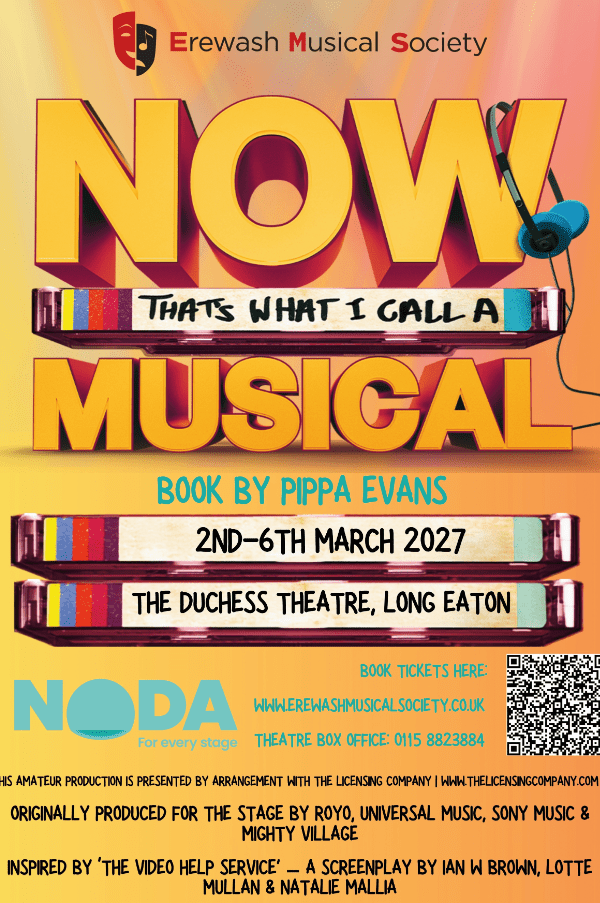
Erewash Musical Society presents Now That’s What I Call a Musical from Tuesday 2 to Saturday 6 March 2027 at The Duchess Theatre, Long Eaton. Book your tickets on TicketSource.
I’ll be writing more about the process as we head towards show week. If you’re new to all this and fancy getting on stage yourself, start with my guide on how to join an amateur theatre society in the UK.