

- 1. The Strategy of Self-Directed Vocal Training
- 2. The Technical Breakdown: Anatomy of the Vocal Instrument
- 3. Three Elite Exercises for Home Practice
- 4. Navigating Digital Resources Safely
- 5. Structuring Your Self-Guided Rehearsal Timeline
- 6. Troubleshooting Common Vocal Hurdles
- 7. Independent Vocal Study as an Empowering Path
Every theatrical production demands absolute vocal control, rock-solid pitch, and an unshakeable understanding of your own instrument. Whether you are navigating the complex harmonic architecture of a ensemble number or stepping center stage for a principal solo, a reliable vocal technique is non-negotiable. As a long-time musical theatre performer and a second soprano, I have spent years working within the vocal landscape that sits directly between the driving power of the alto section and the soaring high notes of the first sopranos. This specific register requires exceptional balance, athletic breath management, and technical precision.
The most pervasive and damaging misconception in the amateur theatre community is that elite vocal training is a luxury reserved exclusively for those who can afford expensive private coaching. Many highly capable actors and ensemble singers relegate themselves to the background, passing up principal auditions because they believe they lack the financial resources to develop a stage-ready voice.
This guide exists to dismantle that barrier completely. You do not need a high-priced vocal technician on a weekly retainer to develop a powerful, resonant, and emotionally captivating singing voice. The digital era has completely democratized vocal pedagogy, offering an unprecedented wealth of world-class instruction entirely free of charge.
To successfully learn to sing for free, you must approach your training with a high degree of discipline, analytical focus, and structural clarity. This comprehensive guide serves as your definitive operational blueprint. We will break down the exact anatomical principles, high-impact physical routines, and self-evaluation techniques you need to build a professional-quality instrument entirely on your own.
1. The Strategy of Self-Directed Vocal Training
When you eliminate the presence of a live, in-person singing coach, the responsibility for your technical development shifts entirely to you. You must simultaneously act as the performer, the director, and the vocal technician. This requires a fundamental shift in how you practice. You cannot simply sing through your favorite musical scores and hope that your technique improves through sheer repetition. You must develop an acute awareness of the physical sensations in your body and learn to diagnose vocal issues based on objective feedback.
The most vital tool in your free vocal education is an audio recording device. Your internal perception of your own voice is heavily distorted by the conduction of sound waves through the bones of your skull. This is why your voice sounds completely different to you than it does to an audience or a casting panel. To train effectively, you must record your technical exercises and repertoire pieces regularly.
When you listen back, you must set aside emotional self-criticism and instead analyze the recording with technical objectivity. Use the following diagnostic criteria during your evaluations:
- Pitch Center: Is the note perfectly centered on the pitch, or is it sagging flat or pushing sharp due to improper air pressure?
- Tone Quality: Is the sound clean and clear, or is there an unvoiced, breathy quality indicating poor vocal fold closure?
- Vowel Purity: Are your vowels open and acoustically modified for the stage, or are they flat, spread, and conversational?
- Articulatory Precision: Are your consonants biting cleanly to deliver the lyrics, or is jaw tension muffling your diction?
In addition to audio feedback, you must rely heavily on somatic awareness, which is the internal tracking of physical sensations. Independent singers must learn to identify the exact feelings of muscular release, acoustic resonance, and breath engagement. If an exercise causes even a minor sensation of tickling, scratching, pinching, or tightness in your throat, it is an immediate physical signal that your technique is flawed. Healthy singing should always feel as effortless and unconstrained as a heightened form of speech. Your goal is to map these positive physical sensations so you can replicate them under the pressure of a live audition or performance.
2. The Technical Breakdown: Anatomy of the Vocal Instrument
To build a reliable singing voice without a paid coach, you must understand the mechanical systems that govern human sound production. Singing is a physical, athletic discipline. Your voice is not a mysterious gift; it is a complex biological instrument comprised of muscles, ligaments, cartilages, and acoustic spaces. By understanding the science of vocal production, you can systematically troubleshoot your own technical hurdles. We can divide the entire vocal mechanism into three core systems: respiration, phonation, and resonance.
Respiration: The Core Engine
Every beautiful note delivered on a professional stage is powered by a highly efficient breath management system. Think of your breath as the raw energy source for your instrument. If the flow of air is unstable, weak, or uncontrolled, the resulting musical tone will immediately sound thin, breathy, or tight.
The primary obstacle for most independent singers is clavicular breathing, which is the technical term for shallow chest breathing. When a performer faces high-stakes situations like an audition or an opening night performance, the nervous system naturally triggers a shallow, rapid inhalation. This causes the shoulders to rise, the chest to tighten, and the neck muscles to constrict. This type of breath traps air high in the torso, providing zero physical support for the voice and forcing the delicate muscles of the throat to squeeze tight to regulate the air pressure. This is the direct path to vocal fatigue, cracking, and chronic hoarseness.
True theatrical singing requires diaphragmatic, three-dimensional breath support, often referred to in classical pedagogy as appoggio. The diaphragm is a large, dome-shaped muscle that sits horizontally across the base of your ribcage, separating your chest cavity from your abdomen. When you take a correct singing breath, your shoulders remain completely dropped and still, your upper chest stays quiet, and your entire lower torso expands outward in a complete ring. This expansion includes your lower abdomen, your flanks, and your lower back.
This deep inhalation causes the diaphragm to contract and drop down, creating a vacuum that fills the lungs completely while providing a stable, pressurized cushion of air. By slowly engaging your deep abdominal muscles (specifically the transversus abdominis) during exhalation, you can control the speed and steady pressure of the air stream. This allows you to sustain long phrases and support high pitches without adding an ounce of strain to your throat.
Phonation: Sound Production and Registers
Once your respiratory system generates a controlled stream of air, that air travels up your windpipe and passes through your larynx, which is commonly referred to as the voice box. Housed safely inside the larynx are your vocal folds (or vocal cords), which are two delicate, muscular bands of tissue that sit horizontally across your airway. Phonation occurs when your brain signals these folds to come together (adduct) while your breath stream passes between them. The aerodynamic pressure causes them to vibrate against one another at astonishing speeds, converting the raw air into sound waves.
The pitch of the note you sing is dictated entirely by the frequency of these vibrations, which is controlled by the intricate stretching and shortening of the vocal muscles. Independent training must focus on mastering the two primary registers:
- The Chest Voice: Mechanically governed by the thyroarytenoid muscles, this register occurs when your vocal folds are relatively thick, short, and vibrating along their entire mass. This register produces a rich, warm, and powerful tone that closely mirrors your natural speaking voice. It is the absolute foundation for contemporary musical theatre belt styles and dramatic lower-register storytelling.
- The Head Voice: Governed primarily by the cricothyroid muscles, this register takes over as you ascend in pitch. The muscles engage to stretch your vocal folds out, making them thin, long, and taut, much like a violin string being tuned higher. This register creates a floating, crystalline, and classical quality. It is essential for traditional legit musical theatre scores, classical repertoire, and complex soprano harmony lines.
The ultimate challenge for any self-taught singer is navigating the vocal break, or passaggio. This is the transition zone where the voice naturally wants to shift or crack between registers due to a sudden imbalance in muscle coordination. To build a seamless, unified voice, you must train your vocal folds to transition smoothly by developing a “mix voice.” This is a balanced registration that blends the deep physical resonance of the chest voice with the light, flexible tension of the head voice, allowing you to ascend to high pitches with power and safety.
Resonance: Acoustic Amplification
The initial sound wave produced by the vibration of your vocal folds is remarkably quiet and buzzy. On its own, it sounds like a small, unamplified drone. To transform that raw buzz into a glorious, room-filling theatrical tone that can project to the back row of an auditorium, the sound waves must vibrate within the open spaces of your skull. This process is known as resonance.
Your primary resonance chambers are the pharynx (the open space at the back of your throat), your oral cavity (your mouth), and your nasal passages. Many amateur singers mistakenly believe that to increase their volume on stage, they need to push more air through their throat or yell with more physical force. This is an incredibly dangerous habit that can cause physical damage, such as vocal nodules or polyps, over time. True theatrical volume is achieved entirely through the intelligent optimization of your resonance spaces.
By learning to lift your soft palate—the flexible, fleshy tissue at the very back of the roof of your mouth—you instantly create a larger, more vaulted concert hall inside your own throat. This action, combined with a relaxed, dropped jaw and a flat tongue, maximizes the pharyngeal space. When you combine this open throat with forward placement, which means directing the acoustic energy toward the hard palate and the “mask” of your face (the sinus cavities around your eyes and nose), your voice naturally amplifies itself. You gain massive projection, clarity, and richness entirely for free, without putting any unnecessary pressure on your delicate vocal folds.
3. Three Elite Exercises for Home Practice
To translate these anatomical principles into actual, stage-ready results, you must establish a consistent routine of specialized vocalises. You do not need expensive studio equipment, a piano, or specialized sheet music to execute these. You simply need focused attention and a commitment to practicing these three highly effective routines in a quiet space where you can track your physical sensations.
Exercise 1: The Sibilant Hiss (Securing the Breath Motor)
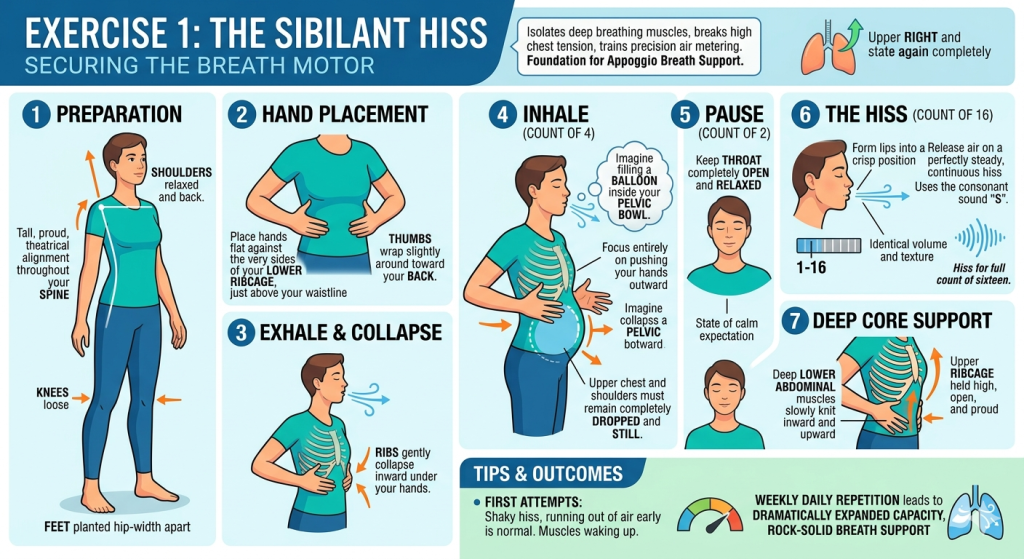
This exercise isolates your deep breathing muscles, breaks the habit of high chest tension, and trains your body to meter out your air supply with absolute precision. It is the absolute foundation of appoggio breath support.
- Stand with your feet planted hip-width apart, ensuring your knees are loose and not locked. Maintain a tall, proud, theatrical alignment throughout your spine, keeping your shoulders relaxed and back.
- Place your hands flat against the very sides of your lower ribcage, just above your waistline, with your thumbs wrapping slightly around toward your back.
- Exhale completely on a slow, controlled sigh, letting your ribs gently collapse inward under your hands.
- Inhale slowly and silently through both your nose and mouth for a count of four. As the air enters, focus entirely on pushing your hands outward using only the expansion of your lower ribs and your lower abdomen. Your upper chest and shoulders must remain completely dropped and still. Imagine filling a balloon inside your pelvic bowl.
- Pause for a count of two, keeping your throat completely open and relaxed, as if you are suspended in a state of calm expectation.
- Form your lips into a tiny, crisp position and release the air on a perfectly steady, continuous hiss, using the consonant sound “S.” Your goal is to keep the hiss at an identical volume and texture for a full count of sixteen.
- As you hiss, feel your deep lower abdominal muscles slowly knit inward and upward to support the air stream, while keeping your upper ribcage held high, open, and proud.
When you first attempt this, you might find that your hiss sounds shaky or that you run out of air early. This is simply a sign that your intercostal and abdominal muscles are waking up to a new athletic demand. Within a few weeks of daily repetition, your capacity will expand dramatically, providing the rock-solid breath support needed to hold long, dramatic phrases without breaking structural alignment.
Exercise 2: The Soft Palate Stretch (Unlocking the Resonant Vault)
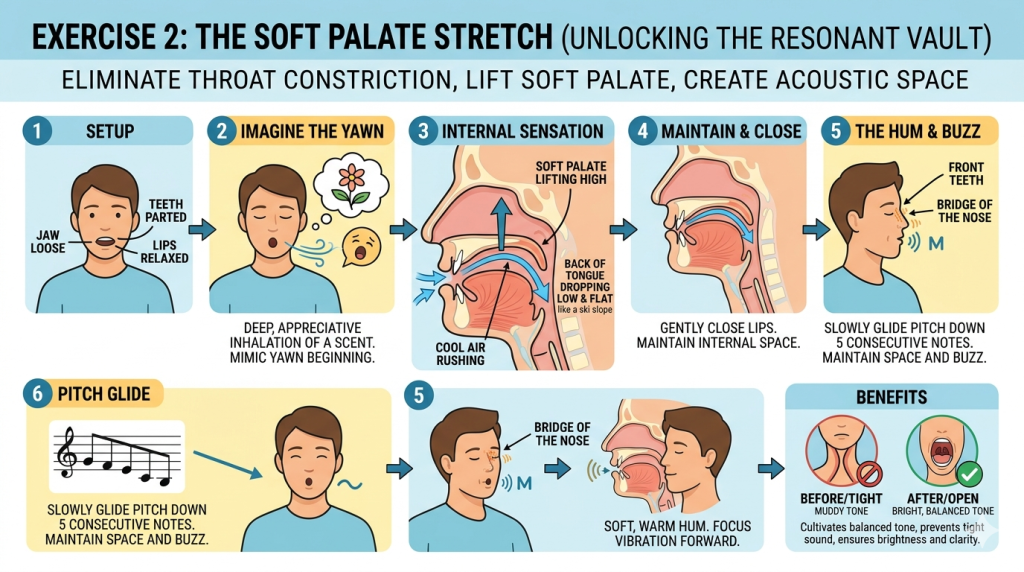
This routine is specifically engineered to eliminate throat constriction, lift your soft palate, and create that beautiful acoustic space that allows your tone to blossom into a rich, professional quality.
- Sit or stand comfortably with your jaw completely loose. Let your teeth part slightly and relax your lips.
- Close your eyes and imagine you are about to take a deep, appreciative inhalation of a wonderful scent, mimicking the very beginning of a warm, luxurious yawn.
- As you take this yawn inhalation, notice the cool air rushing across the back of your throat. You should feel the squishy tissue at the back of the roof of your mouth lift upward, while the back of your tongue drops low and flat like a ski slope.
- Maintain that high, vaulted feeling in the back of your mouth as you gently close your lips.
- On a comfortable, mid-range pitch, begin a soft, warm hum using the consonant “M.”
- Focus entirely on sending the vibration of that hum directly into your front teeth and the bridge of your nose. If you are doing this correctly, your lips should feel an intense, almost ticklish buzzing sensation.
- Slowly glide that humming pitch down five consecutive notes of a scale, maintaining that internal yawn space and that forward buzz the entire time.
This exercise is excellent for cultivating a balanced tone. The internal yawn opens up your throat to prevent a tight, swallowed sound, while the forward hum ensures your voice stays bright and clear rather than becoming muddy or muffled.
Exercise 3: The Connected Siren (Register Blending Masterclass)
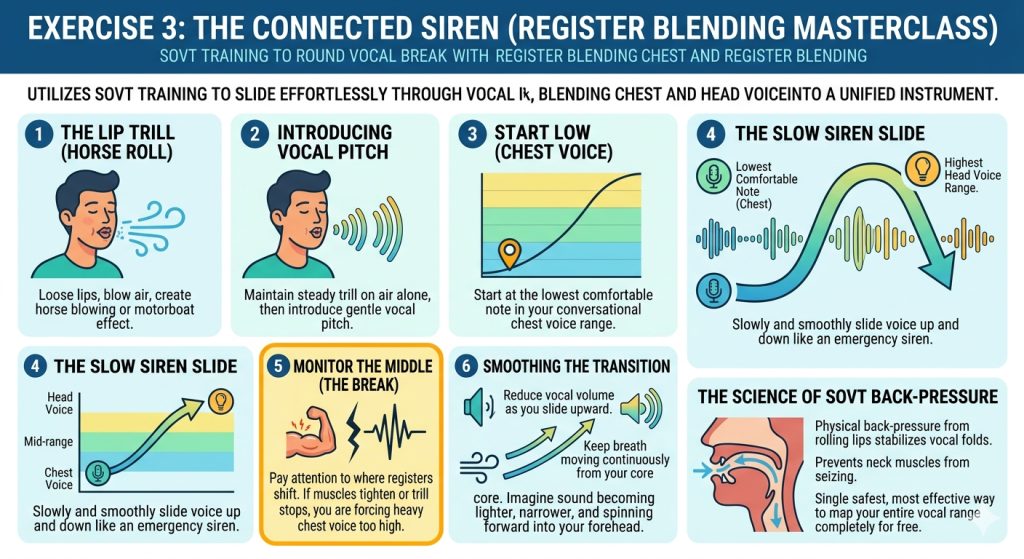
This vocalise utilizes the unique physical properties of Semi-Occluded Vocal Tract (SOVT) training to help you slide effortlessly through your vocal break, blending your chest and head voice into a seamless, unified instrument.
- Bring your lips together loosely and blow air through them to create a relaxed, fluttering roll, exactly like a horse blowing out air or a child mimicking a motorboat. This is known as a lip trill.
- Once you can maintain a steady lip trill on air alone, introduce a gentle vocal pitch to the vibration.
- Start at the absolute lowest, most comfortable note in your current singing range (your conversational chest voice).
- Slowly and smoothly, slide your voice all the way up to the top of your comfortable head voice range, and then slide back down to the bottom, just like a slow, sweeping emergency siren.
- Pay close attention to the middle of your voice where your registers naturally want to shift or crack. If you feel your throat muscles tighten or if the lip trill suddenly stops, it means you are trying to force your heavy chest voice too high.
- To fix this, reduce your vocal volume as you slide upward, keep your breath moving continuously from your core, and imagine the sound becoming lighter, narrower, and spinning forward into your forehead.
The physical back-pressure created by the rolling lips sends acoustic energy back down your vocal tract, keeping your vocal folds stabilized and preventing the surrounding neck muscles from seizing up. It is the single safest, most effective way to map out your entire vocal range completely for free.
4. Navigating Digital Resources Safely
When you search for free singing lessons online, you will quickly discover that the internet is a vast, unregulated conservatory. For every world-class vocal scientist sharing free, evidence-based training videos, there are dozens of amateur coaches offering highly suspect advice that can easily lead to bad habits or vocal strain. To maximize your time and protect your vocal health, you must approach digital learning with a discerning, analytical mind.
The key to curated, highly effective independent study is seeking out established vocal pedagogues who back up their exercises with actual anatomical facts. Look for coaches who explicitly explain the physical why behind an exercise, rather than those who simply tell you to copy their sound. Elite institutions and globally renowned coaches frequently upload complete, highly structured beginner series to public video platforms, offering professional-grade warm-ups, diction drills, and style tutorials without requiring a paid subscription.
When utilizing high-quality video demonstrations alongside this guide, focus heavily on the physical postures and adjustments modelled by the instructor. Watch the alignment of their neck, the relaxation of their jaw, and the specific mouth shapes they use for different vowels. Seeing a professional educator demonstrate these physical adjustments provides invaluable context that you can instantly replicate and audit in front of a mirror in your own home studio space.
5. Structuring Your Self-Guided Rehearsal Timeline
To turn your access to free singing lessons into genuine, stage-ready authority, you must approach your independent practice with the discipline of a professional performer. You cannot simply sing through your favourite show tunes in the shower and expect your technique to transform overnight. You need a structured, deliberate practice blueprint that targets every aspect of your vocal instrument.
Commit to a dedicated twenty to thirty-minute practice block at least four to five times a week. Consistency is infinitely more valuable than a grueling two-hour session once a week, as your vocal folds rely on muscle memory and gentle, repetitive conditioning to build strength and flexibility without fatigue. Structure each individual practice session into four distinct movements:
| Segment | Duration | Focus Area | Recommended Exercises |
| Movement 1: Alignment & Core Connection | 5 Minutes | Physical release and activating the respiratory system. | Full-body stretches, shoulder rolls, neck releases, and the Sibilant Hiss routine. |
| Movement 2: Technical Vocalises | 7–10 Minutes | Coordination of vocal folds and acoustic resonance tuning. | Semi-occluded lip trills, forward-placed humming routines, and gentle five-note scales. |
| Movement 3: Repertoire Application | 10 Minutes | Integrating technical mechanics directly into theatrical text. | Isolate a difficult four-bar phrase; sing it first on an SOVT lip trill or a neutral vowel before adding the lyrics back. |
| Movement 4: Vocal Cool-Down | 2 Minutes | Relaxing laryngeal muscles and returning the voice to a speaking state. | Gentle descending hums, quiet low-register sliding sighs, and jaw relaxation stretches. |
By treating your practice with this level of professional respect, you ensure steady, measurable growth that will protect your longevity and enhance your performance capabilities at your very next theatre audition.
6. Troubleshooting Common Vocal Hurdles
When learning to sing without an instructor physically present in the room, you must remain alert to common vocal pitfalls. Identifying these mechanical errors early prevents bad habits from hardening into permanent muscle memory.
Pitfall 1: Vocal Strain and Squeezing on High Notes
If you experience a pinching or squeezing sensation in your throat when reaching for higher pitches, you are likely pushing too much air pressure against your vocal cords or trying to carry your heavy chest register too high. This error forces your larynx to pull upward toward your jaw, clamping your throat shut and cutting off your resonance.
- How to Correct It: Reduce your volume by half as you approach the higher notes. Focus on relaxing your jaw completely and imagining that the sound is traveling up and over into your forehead rather than being pushed straight out of your mouth. Keep your breath moving steadily from your core, but do not push hard. Allow the sound to become lighter and more circular.
Pitfall 2: Chronic Breathiness and Poor Closure
While a breathy vocal tone can be used occasionally as an intentional stylistic choice in contemporary pop-theatre ballads, a chronic inability to produce a clear, ringing sound is a sign of poor vocal fold closure. This means air is escaping through your vocal cords without being fully converted into sound waves, which tires out your voice quickly and limits your projection.
- How to Correct It: Integrate glottal onset exercises into your warm-up routine. Practice saying short, staccato words that start with vowels, such as “Up,” “Eat,” “Oat,” or “Apples,” with a crisp, clean start to the sound. Ensure there is no air leaking before the sound begins. This trains your vocal folds to come together cleanly, firmly, and efficiently at the exact microsecond the breath arrives.
Pitfall 3: Vowel Distortion and Nasal Tone Production
There is a major technical difference between healthy forward resonance and a truly nasal tone. Forward resonance uses the bones of your skull to amplify sound safely. A nasal tone occurs when your soft palate drops low, forcing the sound waves to travel entirely through your nasal cavity, resulting in a thin, pinched, and whiny quality that distorts your vowels.
- How to Correct It: Conduct a quick physical audit. Sing a sustained vowel like “Ah” or “Oh” on a single pitch and pinch your nose shut with your fingers. If the sound changes dramatically, becomes muffled, or stops completely, your tone is excessively nasal due to a dropped palate. To fix this, practice the soft palate stretch exercise to lift the back of your throat, ensuring the sound waves escape entirely through your open mouth while maintaining a bright, forward ring.
7. Independent Vocal Study as an Empowering Path
Independent vocal study is one of the most empowering, deeply rewarding journeys an amateur performer can ever embark upon. It transforms singing from a stressful, unpredictable guessing game into a beautiful, highly controlled craft that you completely command. You do not need an expensive studio address or a prestigious certificate to claim your right to a stunning, expressive, and powerful theatrical voice. You simply need the discipline to practice consistently, the curiosity to study your own physical sensations, and the confidence to stand center stage and share your unique artistry with the world.
Now, as we prepare to look toward the next technical guides in our vocal training series, I want to open the stage to our community.
What specific vocal challenges have you been facing in your local theatre rehearsals that you are excited to tackle using these independent training strategies? If you are a fellow second soprano or ensemble singer, how do you balance your registration when navigating those tricky intermediate harmony lines? Which of the three daily exercises we broke down today gave you that immediate, wonderful sense of physical freedom and resonance?
Let us keep this supportive, authoritative conversation flowing in the comments section below. Share your technical breakthroughs, ask your burning vocal health questions, and let us build an exceptional digital academy together. Until our next masterclass, keep your alignment tall, keep your breath supported deep from your core, and may your high notes ring clear and your vocal folds remain healthy. Rehearsal dismissed!