
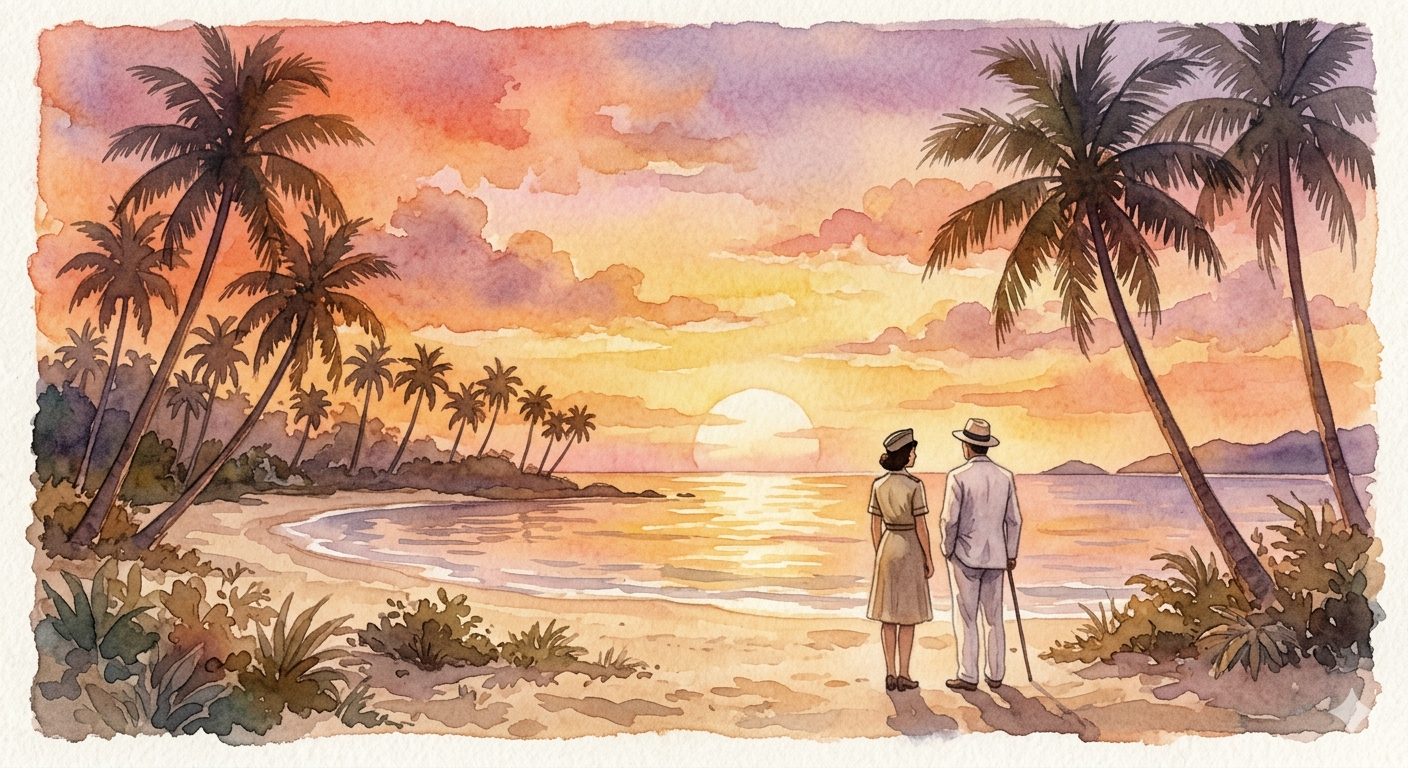
There is arguably no more beautiful collection of songs in all of musical theatre than the score of South Pacific. Set the scene: it’s the Second World War, the location is a lush, dangerous tropical island, and against all the odds, two unlikely love stories are blooming in the middle of it.
Rodgers and Hammerstein’s South Pacific isn’t just a great musical. It’s one of the most important pieces of theatre America ever produced, a show that dared to talk about prejudice in 1949 and refused to back down when audiences pushed back. It’s also, simply, gorgeous to listen to from start to finish.
If you’ve heard the songs without knowing the show, or you’re an amateur society weighing it up for your next season, here’s everything you need to know.
What Is South Pacific?
South Pacific has music by Richard Rodgers and lyrics by Oscar Hammerstein II, with the book co-written by Hammerstein and Joshua Logan. It’s based on James Michener’s “Tales of the South Pacific,” a collection of stories that won the Pulitzer Prize for Fiction in 1948.
The show opened on Broadway in April 1949 and went on to win ten Tony Awards, a clean sweep of every category it was nominated in, including Best Musical, Best Score and all four acting awards for Mary Martin, Ezio Pinza, Myron McCormick and Juanita Hall. It remains one of the most performed musicals in amateur theatre history, and for good reason. The score is extraordinary, the story still lands, and it gives a cast the kind of material actors dream about.

The Story of South Pacific
South Pacific follows two parallel love stories, both shaped by the same uncomfortable truth: prejudice doesn’t disappear just because two people are far from home.
Ensign Nellie Forbush, a US Navy nurse from Arkansas, falls for Emile de Becque, a French plantation owner living on the island. Their romance is warm and funny and entirely believable, right up until Nellie discovers that Emile’s two children are the result of his first marriage to a Polynesian woman. Her own prejudice, the kind she’s never had to examine before, suddenly has a name and a face, and the show doesn’t let her, or the audience, off the hook for it.
Running alongside this is the story of Lieutenant Joe Cable, a young officer who falls in love with Liat, a Tonkinese girl, but can’t quite bring himself to imagine marrying her and bringing her home. His arc is the show’s most tragic, and it ends in heartbreak that’s impossible to forget.
Both storylines circle the same theme. Where does prejudice actually come from? Hammerstein’s answer, delivered through the show’s most famous lyric, is blunt: it’s carefully taught. Act One builds the romances with warmth and comedy. Act Two is where the consequences of that prejudice play out, and where the show asks its audience to sit with something genuinely uncomfortable.
The Songs in South Pacific
This is one of those scores where almost every number is a standard in its own right.
“Some Enchanted Evening” is one of the most famous songs in the entire musical theatre canon, Emile’s declaration of a love that arrives without warning and without logic.
“I’m Gonna Wash That Man Right Outa My Hair” is Nellie’s defiant, funny rejection of her own feelings, sung while actually washing her hair on stage.
“Bali Ha’i” belongs to Bloody Mary and is one of the most atmospheric numbers ever written, mystical, exotic and completely unforgettable.
“Younger Than Springtime” is Cable’s love song to Liat, tender and aching.
“There Is Nothing Like a Dame” is the male ensemble number everyone knows, a comic, full-throated complaint from men who haven’t seen a woman in months.
“This Nearly Was Mine” is Emile’s Act Two heartbreak, and it demands a serious baritone with the vocal weight to carry real devastation.
“Honey Bun” is pure comic relief, a show-stopping novelty number performed within the show’s own military concert.
“You’ve Got to Be Carefully Taught” is, by some distance, the most important ninety seconds in the show. It states the central argument outright: prejudice isn’t natural, it’s learned, and it can be unlearned too.
The Characters in South Pacific
Ensign Nellie Forbush is the lead, a soprano role that needs warmth, comic timing and the courage to play a character whose flaws are the whole point.
Emile de Becque is a bass-baritone role that needs genuine vocal weight. This isn’t a part you can cast on charisma alone. The voice has to be there.
Lieutenant Joe Cable is a tenor role carrying the show’s most tragic arc.
Bloody Mary is a mezzo character role and one of the great scene-stealers in musical theatre, sharp, funny and unexpectedly moving.
Liat is often played as a largely non-speaking, dancing role, which makes the casting of her physical performance crucial.
Luther Billis is the comedy baritone, the island’s resident wheeler-dealer and the source of much of the show’s comic energy.
If you’re not sure what any of these voice types actually mean in practice, my guide to vocal types in musical theatre breaks it down.

Is South Pacific Right for Your Amateur Society?
The honest answer is that it depends heavily on your casting pool, and that’s worth saying plainly rather than dancing around it.
The vocal demands are not optional. Emile needs a real bass-baritone and Nellie needs a true soprano. These two roles carry the emotional weight of the entire show, and if the voices aren’t there, no amount of staging will fix it. Be realistic about who you have before you commit to programming this one.
The ensemble is large, which makes South Pacific a great choice for societies with strong numbers, particularly among male performers, since the sailor ensemble is a significant part of the show’s energy.
The set can be done beautifully or simply. The island setting is evocative, but it doesn’t require elaborate scenery to work. Lighting and sound design can carry a huge amount of the atmosphere.
The orchestration is rich and complex. Consider honestly what band you can field, and whether a reduced orchestration will serve the score or compromise it.
The thematic weight matters. This show deals directly with racism and prejudice, and it doesn’t soften the conversation for comfort. Societies taking this on should think carefully about how they want to frame and discuss that material with their cast and audience, not as a barrier to staging it, but as part of doing it justice.
Licensing for South Pacific is available through Concord Theatricals. Check their site for current availability and terms before programming.
South Pacific on Stage: What to Expect as an Audience Member
South Pacific runs at roughly two and a half hours including an interval, though exact running times vary by production.
Expect to laugh in Act One and feel genuinely unsettled in Act Two. The show earns both reactions honestly. The music carries enormous emotional weight throughout, and even audience members who don’t know the plot will likely recognise several of the songs the moment the orchestra starts.
It’s a show that rewards audiences who are willing to sit with discomfort as well as romance, which is exactly what made it groundbreaking in 1949 and exactly why it still resonates now.
Notable Productions of South Pacific
The original 1949 Broadway production starred Mary Martin and Ezio Pinza and swept the Tony Awards.
The 2008 Lincoln Center revival, directed by Bartlett Sher and starring Kelli O’Hara and Paulo Szot, is widely considered the definitive modern production and is the version many people first discover the show through on recording.
More recently, a major UK touring production directed by Daniel Evans opened at Sadler’s Wells in London in 2022, led by Julian Ovenden and Gina Beck, before touring extensively across the UK and Ireland. Check ATG Tickets or your local theatre’s listings for any professional productions touring near you.
Frequently Asked Questions About South Pacific
What is South Pacific the musical about? South Pacific tells two parallel love stories set on a Pacific island during the Second World War. Nellie Forbush, a US Navy nurse, falls for French planter Emile de Becque, while Lieutenant Joe Cable falls for a young Tonkinese woman named Liat. The show centres on prejudice and where it really comes from.
Who wrote South Pacific? The music was written by Richard Rodgers and the lyrics by Oscar Hammerstein II, with the book co-written by Hammerstein and Joshua Logan. It’s based on James Michener’s Pulitzer Prize-winning “Tales of the South Pacific.”
How many Tony Awards did South Pacific win? South Pacific won ten Tony Awards at the 1950 ceremony, sweeping every category in which it was nominated, including Best Musical and all four acting awards.
What is the most famous song from South Pacific? “Some Enchanted Evening” is the show’s most famous number and one of the most recognisable songs in musical theatre history. “Bali Ha’i” and “There Is Nothing Like a Dame” are close behind in cultural recognition.
Is South Pacific suitable for amateur theatre? Yes, though the vocal demands for Emile and Nellie are significant and shouldn’t be underestimated. Societies with a strong soprano and bass-baritone, plus good numbers for the ensemble, are well placed to do the show justice.
How long is South Pacific? Approximately two and a half hours including an interval, though this varies by production.
Is South Pacific based on a true story? It’s based on James Michener’s “Tales of the South Pacific,” a collection of fictional but war-informed stories drawn from his own experience serving in the Pacific during the Second World War.
Does South Pacific deal with racism? Yes, directly and deliberately. The song “You’ve Got to Be Carefully Taught” makes the show’s argument explicit: prejudice is learned, not innate. It was a genuinely radical statement for a mainstream Broadway musical in 1949 and remains central to the show’s purpose.
Where to See South Pacific
South Pacific is performed regularly by amateur and professional companies, and major revivals tend to generate UK-wide tours, so it’s worth keeping an eye on listings even outside of London.
The best place to check for current professional productions is official theatre listings, ATG Tickets, or Rodgers and Hammerstein’s own production pages. For amateur productions, check your local am dram society listings or NODA’s regional pages. If you’re not in a society yet, my guide on how to join an amateur theatre society in the UK is a good place to start.