
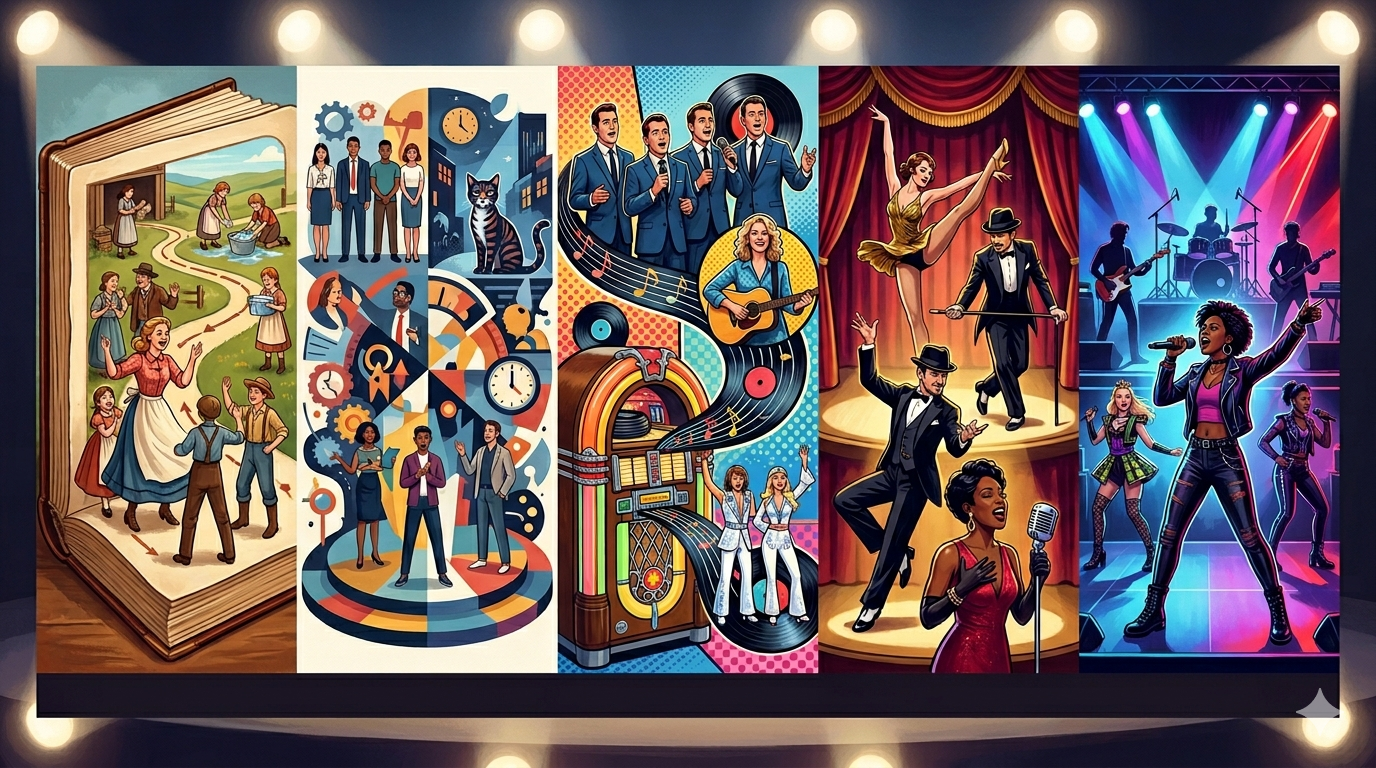
What exactly constitutes a musical? At its core, musical theatre is an artistic medium that synthesizes songs, spoken dialogue, acting, and dance to communicate a narrative or explore a thematic thesis. The specific balance of these constituent parts determines the exact category a production falls into.
The theatrical industry classifies lyrical stage productions into five distinct models: the book musical, the concept musical, the jukebox musical, the revue, and the rock or pop musical.
Understanding this structural taxonomy is far more than a simple academic exercise. For performers, identifying the foundational type of a production is a prerequisite for intelligent audition preparation, precise character development, and healthy vocal mechanics. For theatrical writers and marketers, these categories dictate user intent and search behavior. Audiences look for specific theatrical experiences based on these definitions, making this structural understanding the ultimate framework for analyzing, performing, and ranking musical theatre content.
1. The Book Musical
Core Concept and Dramatic Integration
The book musical stands as the traditional backbone of modern commercial theatre. In this specific format, the narrative script (commonly referred to as the libretto, or “the book”) acts as the absolute driving force of the production. Every single element of the staging, including the musical numbers, the lyrical content, and the choreography, exists for a singular purpose: to progress the plot, advance character relationships, or heighten immediate dramatic stakes.
In a perfectly constructed book musical, you cannot extract a musical number without creating an immediate, confusing gap in the storyline. The music functions as a direct extension of the spoken script. Characters speak until their emotional thresholds are surpassed, at which point singing becomes the only viable method to communicate their internal psychological states.
Anatomy and Chronological Structure
Book musicals follow a highly organized, chronological narrative arc that mirrors classic Aristotelian dramatic structure. This formula relies on specific storytelling movements:
- The Exposition and World-Building: This opening sequence introduces the baseline reality, the social hierarchy, and the geographic setting of the story.
- The Inciting Incident: A sudden disruption or conflict forces the primary characters out of their established routines and sets the central conflict into motion.
- The “I Want” Song: Positioned early in the first act, this musical number explicitly outlines the protagonist’s core desire, establishing the motivation that will dictate their decisions for the rest of the evening.
- Rising Action and the Act One Finale: A sequence of escalating complications that culminates in a massive narrative cliffhanger right before the interval, ensuring the audience returns for the second half.
- The Climax: The absolute peak of emotional and narrative tension in the second act where the primary forces collide.
- The Resolution: A swift tying up of subplots and loose ends, establishing a new baseline reality for the surviving characters.
Historical Benchmarks
The integrated book musical was first popularized by Jerome Kern and Oscar Hammerstein II with their 1927 production Show Boat. This historic show proved that musical theatre could step away from lightweight variety entertainment to address deep social issues through an organized, serious plot.
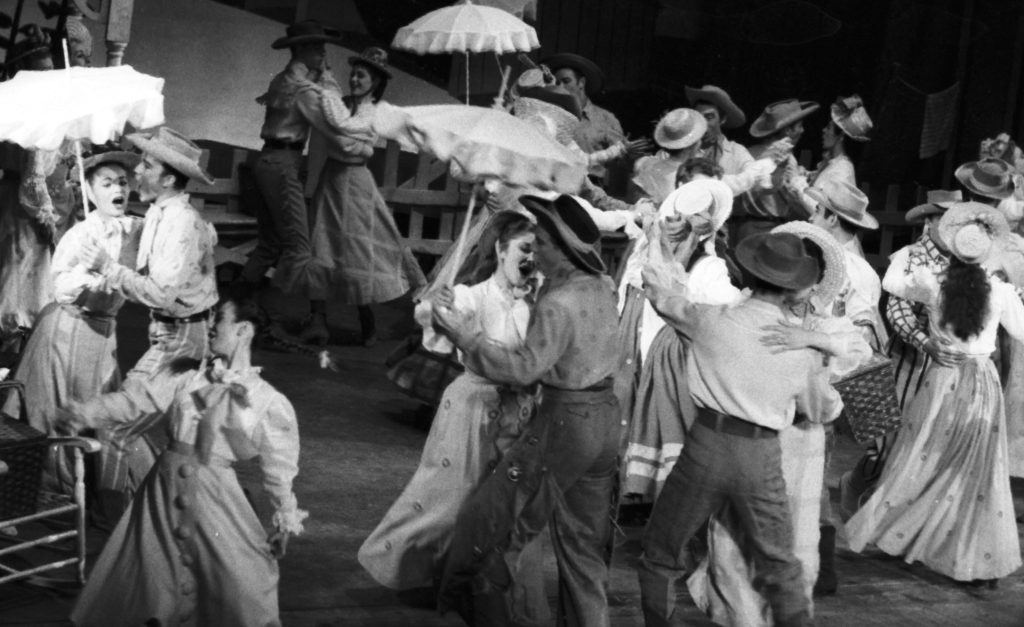
The structural formula reached absolute perfection during the Golden Age of musical theatre, a golden era initiated by Rodgers and Hammerstein’s Oklahoma! in 1943. This production famously drafted choreography into the service of script interpretation, utilizing a fifteen-minute dream ballet to reveal the deep psychological anxieties of the lead female character.
The Performer’s Reality
From a performance perspective, book musicals require intense text analysis. You must treat the lyrics exactly like heightened spoken dialogue, breaking down specific beats, character objectives, and immediate tactics.
My experiences performing as Gertie Cummings in Oklahoma! and July in Annie revealed exactly how character-driven this specific structure is. When playing Gertie, her musical moments and her famously distinct, grating laugh are not random comic additions: they are calculated tactical moves designed to irritate Laurey and shift the social balance within the scene. In Annie, iconic numbers like “It’s the Hard-Knock Life” are not decorative ensemble showstoppers. Instead, they establish the grim, daily operational reality of the orphanage, providing the direct emotional justification for July and the other orphans’ desperate actions. Every line requires a grounded acting choice rooted in the script.
2. The Concept Musical
Thematic Ascendancy over Plot
The concept musical completely flips the traditional script by prioritizing a central theme, philosophy, message, or metaphor over a linear narrative. Instead of answering the standard plot-driven question “What happens next?”, a concept musical spends its entire running time answering a deeply psychological question: “What does this specific human experience feel like?”.
The storyline in a concept musical is actively deprioritized, frequently serving as a minimalist structure upon which various thematic explorations are displayed. These productions examine a single issue from multiple, often contradictory angles, shifting perspectives rapidly from scene to scene.
Structural Episodic Framework
The structural architecture of a concept musical is fundamentally episodic rather than chronological. Scenes are connected solely by their shared relationship to the central motif, completely abandoning cause-and-effect storytelling.
Time, geography, and physical space remain entirely fluid in these productions. Characters often exist within an abstract, liminal environment (such as an empty rehearsal stage, a fractured memory, or a stylized conceptual representation of an urban space) rather than a realistic set. Writers frequently use a dedicated framing device, a narrator, a master of ceremonies, or a structured real-world event, to anchor the various theatrical vignettes and ensure the audience maintains a intellectual connection to the theme.
Historical Catalysts
While early foundations were laid during the experimental theatre movements of the late 1960s, the concept musical became a dominant commercial force in the 1970s. This shift was driven by the legendary collaborations of composer Stephen Sondheim and director Hal Prince.
Their 1970 masterpiece Company stands as the definitive blueprint for the genre, deconstructing upper-middle-class marriage and commitment through the eyes of a single thirty-five-year-old bachelor, Bobby, during a series of disconnected social visits. Other monumental historical markers include Bob Fosse’s cynical, vaudeville-framed Chicago, Michael Bennett’s A Chorus Line (which organizes its entire performance around a grueling Broadway audition), and Andrew Lloyd Webber’s Cats, which uses an abstract poetry collection to explore death, choice, and spiritual rebirth.
The Performer’s Reality
Performing in a concept musical demands exceptional artistic versatility and emotional intelligence. Because the traditional narrative arc is missing, you cannot rely on a standard chronological buildup of emotion. Instead, you must be capable of generating high-stakes emotional realities instantly within standalone scenes.
Actors in these shows frequently portray abstract archetypes, psychological fragments, or multiple completely unrelated characters rather than a single individual with a clear linear journey. The work requires a high comfort level with breaking the fourth wall, addressing the audience directly to deliver the production’s core philosophical argument.
3. The Jukebox Musical
Commercial Proximity and Musical Curation
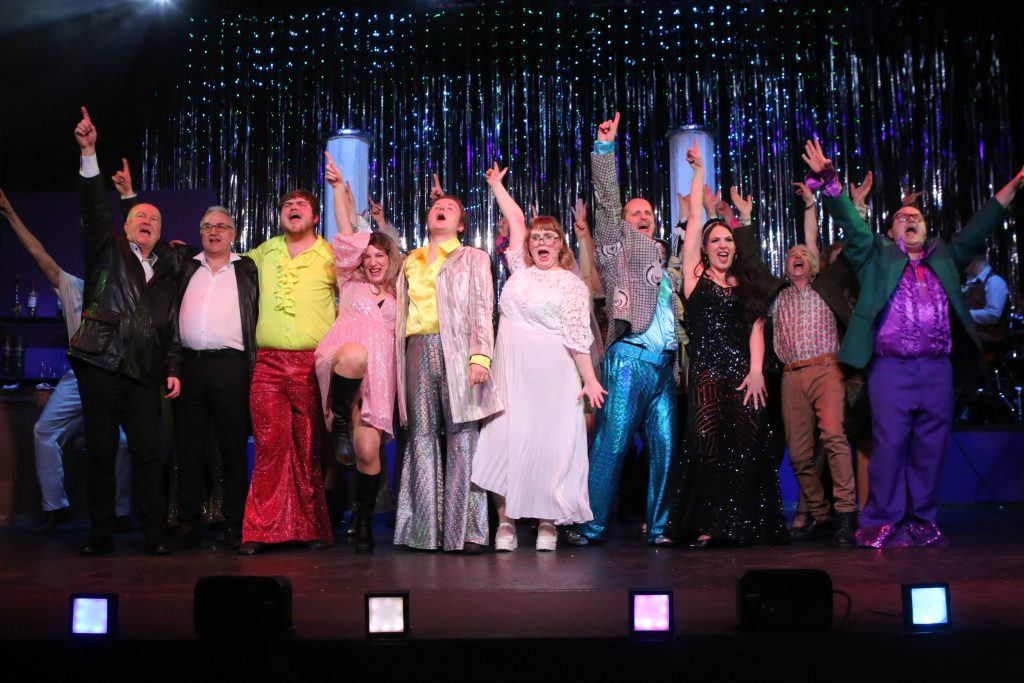
The jukebox musical constructs its entire musical score from pre-existing popular songs rather than utilizing an original score written explicitly for the stage. The primary commercial mechanism here is immediate familiarity, attracting audiences who already possess a deep emotional investment in the featured music. The artistic objective of a jukebox musical centers on taking tracks originally engineered for commercial radio and retrofitting them into a live, dramatic theatrical space.
The Two Structural Pillars
Jukebox musicals divide into two distinct operational formats, each presenting unique scriptwriting hurdles:
- The Biographical Narrative: This model tracks the documented, real-world history of the specific musical artist, songwriter, or performing group. The songs are typically performed diegetically, meaning the characters are fully aware they are singing within the context of a concert, a recording session, or a television appearance. Prominent examples include Jersey Boys (The Four Seasons), Beautiful: The Carole King Musical, and Tina: The Musical.
- The Original Fictional Narrative: This model invents a completely new, fictional plot from scratch. The writers then meticulously shoehorn pre-existing lyrics into the mouths of characters, forcing the popular songs to serve as plot-advancing dialogue or expressions of internal character conflict. Leading examples include Mamma Mia! (ABBA), We Will Rock You (Queen), and & Juliet (Max Martin).
Historical Growth
While the practice of compiling popular tunes into stage shows stretches back to 18th-century ballad operas, the modern commercial gold rush was triggered in 1999 by the West End premiere of Mamma Mia!. By weaving the bright pop catalog of ABBA into a lighthearted story about family secrets on a Greek island, the creators unlocked an incredibly lucrative theatrical formula.
A few years later, Jersey Boys (2005) completely elevated the artistic reputation of the genre, winning widespread critical praise for its gritty, documentary-style look at the working-class origins and legal battles of The Four Seasons.
Vocal Mechanics and Stamina
For the performer, the jukebox genre introduces serious physiological demands that differ wildly from classical theatre. These productions require incredible vocal stamina and an absolute mastery of contemporary pop and rock vocal styling.
You must consciously step away from traditional, legit musical theatre head resonance and instead utilize heavy chest-voice belting, vocal distortions, stylized riffs, and forward contemporary placements. The ultimate acting challenge in a jukebox show involves delivering incredibly famous radio hits with complete dramatic sincerity, convincing a savvy audience that these well-known pop lyrics are actually the spontaneous, organic thoughts of your character.
4. The Revue
The Variety Format and Non-Narrative Flow
The revue is a strictly non-storytelling format that presents a highly curated collection of songs, dances, comedic sketches, and dramatic monologues. While a concept musical uses an abstract structure to dissect a specific intellectual thesis, a revue is designed for direct entertainment, historical celebration, or a career retrospective of a specific composer’s catalog. There is absolutely no narrative plot or character consistency connecting the individual numbers.
Structural Curation and Pacing
A revue is built around a sequence of self-contained acts. Because there is no storyline to pull the audience forward, the evening relies entirely on stylistic variety, emotional pacing, and sheer performance skill to maintain engagement.
Performers in a revue rarely have specific character names: they are typically credited as themselves or as members of a core vocal ensemble. The cohesion of the production relies entirely on a shared artistic aesthetic, such as celebrating the music of a specific decade, highlighting a distinct genre, or honoring the output of a legendary writing team.
Historical Roots
The origins of the revue lie within 19th-century vaudeville, music hall traditions, and satirical burlesque. Early in the 20th century, commercial showmen like Florenz Ziegfeld elevated the format into a high-art spectacle with the legendary Ziegfeld Follies, focusing on massive production values, opulence, and star-vehicle comedy sketches.
In the modern era, the format has shifted toward intimate, sophisticated celebrations of musical theatre history. Side by Side by Sondheim (1976) introduced mainstream audiences to the intricate lyrical complexities of Stephen Sondheim’s early catalog. Similarly, Ain’t Misbehavin’ (1978) honored the historic jazz contributions of Fats Waller and the Harlem Renaissance, while Fosse (1999) served as a precise, three-act masterclass showcasing the distinct choreographic vocabulary of director Bob Fosse.
The Performer’s Reality
In a revue format, there is absolutely nowhere for a performer to hide. Without a long narrative arc or a deep character mask to protect you, your raw technical precision must be flawless.
Vocalists must deliver stylistically accurate, emotionally complete interpretations of a wide range of music, frequently jumping from a devastating dramatic ballad to a highly complex, fast-paced comedic patter song within a matter of minutes. Dancers face a similar challenge, mastering completely different choreographic styles back-to-back without the benefit of an ongoing storyline to help the audience interpret their physical movements.
5. The Rock/Pop Musical
Sonic Modernisation and Cultural Rebellion
The rock or pop musical is identified specifically by its modern instrumentation, its contemporary vocal production styles, and its proximity to commercial music charts. While it frequently borrows the structural storytelling techniques found in traditional book musicals or concept musicals, its distinct cultural impact, specialized instrumentation, and unique performance demands require it to stand as an independent category.
These productions completely retire the traditional string-and-woodwind theatre orchestra, replacing it with high-output rock bands, synthesizers, electric guitars, and acoustic drum kits, bringing the raw sonic energy of youth culture directly into the auditorium.
Instrumental and Technical Architecture
Rock and pop musicals frequently utilize a sung-through structure, where traditional spoken dialogue is minimized or entirely eliminated. The story is communicated via continuous musical composition, modern recitative, or highly rhythmic prose delivered over a driving rhythm section.
Because of this contemporary musical framework, these productions regularly tackle counter-cultural themes, deep modern social anxieties, political rebellion, or gritty coming-of-age stories that naturally match the raw, aggressive energy of rock and pop music.
Historical Milestones
The genre officially shattered the traditional Broadway mold with the arrival of Hair in 1968, which brought the 1960s anti-war movement and rock concert culture directly into a classic Broadway theatre house. This historic breakthrough cleared a path for Andrew Lloyd Webber and Tim Rice’s Jesus Christ Superstar (1971), a show that was conceptualized and sold as a rock opera before it ever touched a live stage.
In 1996, Jonathan Larson’s Rent completely revitalized the genre, adapting Puccini’s classical opera La Bohème into a contemporary story tracking the lives of young artists dealing with poverty and the HIV/AIDS epidemic in New York’s East Village. The lineage extends straight into the modern era through massive commercial blockbusters like Toby Marlow and Lucy Moss’s Six, which restructures the tragic histories of Henry VIII’s wives into a high-octane pop concert, and Lin-Manuel Miranda’s hip-hop masterpiece Hamilton.
Vocal Production and Microphone Technique
The rock and pop genre requires a complete reassessment of vocal production and audio technique. Performers are almost universally fitted with high-sensitivity head microphones or are required to handle specialized handheld performance mics. This means you must understand how to let the sound amplification system handle the projection, allowing you to avoid vocal strain while maintaining an aggressive edge.
Stepping into the role of Joanne Jefferson in Rent is an absolute dream role and a major performance goal of mine. Her complex vocal track, particularly during the explosive rock duet “Take Me or Leave Me”, demands a flawless mix of deep blues styling, modern vocal placement, and an uninhibited, emotionally charged rock belt. Performers in this category must combine deep, authentic emotional vulnerability with the commanding stage presence of a professional rock star.
Comprehensive Structural Comparison
To easily evaluate how these five core categories operate across key production metrics, use the comparative framework below:
| Musical Type | Narrative Structure | Score Origins | Character Development | Primary Performance Focus | Key Industry Examples |
| Book Musical | Linear, chronological, cause-and-effect plot structure. | Original music composed explicitly to match the script. | Deep, continuous, highly psychological character growth. | Integrated acting, singing, and storytelling technique. | Oklahoma!, Annie, The Sound of Music, Wicked |
| Concept Musical | Episodic, non-linear, organized strictly by theme. | Original music written to explore a specific thesis. | Archetypal, symbolic, or multi-faceted representations. | Stylised movement and direct audience address. | Company, A Chorus Line, Cats, Pippin |
| Jukebox Musical | Linear plot or chronological biographical timeline. | Pre-existing popular hit music or specific artist catalogs. | Highly dependent on biographical data or script frame. | High-stamina contemporary pop/rock vocal styling. | Mamma Mia!, Jersey Boys, & Juliet, Beautiful |
| The Revue | Entirely non-narrative, sequence of standalone acts. | Pre-existing or curated thematic compilations. | None, performers appear as themselves or in fast vignettes. | Extreme technical versatility and direct presentation. | Side by Side by Sondheim, Ain’t Misbehavin’, Fosse |
| Rock/Pop Musical | Frequently sung-through with fast, modern pacing. | Original modern rock, pop, or hip-hop musical composition. | High-stakes emotional states with counter-cultural focus. | High-energy contemporary vocal production and microphone control. | Rent, Six, Hamilton, Spring Awakening |
The Cross-Pollination of Modern Theatre
While mastering these five fundamental definitions is essential for building a clean site architecture and organizing your content strategy, modern theatrical writers are constantly blending these genres to produce unique hybrid works.
Consider Hamilton: it utilizes the historical, biographical framework of a classic book musical, communicates its story via the completely sung-through score of a rock/pop musical, and frames its opening sequences using the abstract presentation techniques of a concept musical. Similarly, Six masterfully executes a high-energy pop concert revue while remaining anchored to a competitive concept structure.
By fully grasping these five core models, you can analyze your favorite West End and Broadway productions with deep technical insight, approach any audition side with instant professional clarity, and construct highly authoritative content that satisfies exact user search intent across the theatre niche.